Can Again Fire Tv Connect to a 5g Network
Wi-Fi networking provides united states of america with 2 bands for the operation of wireless LAN networks: the ii.4Ghz band and the 5GHz band. The 2.4GHz band has a reputation of beingness something of a "sewer" of a ring, due to its limited number of usable channels, the number of Wi-Fi devices already using the ring, and the loftier levels of non-Wi-Fi interference that information technology experiences. Many wireless LAN professionals will generally propose that you put your "important stuff" on the 5GHz band whenever possible. 5GHz has far more channels available, a corresponding lower number of devices per channel, and generally suffers much lower non-Wi-Fi interference. However, beneath the headline of "2.4Ghz = bad, 5Ghz = practiced", there lurks a shadowy effigy that can exist troublesome if yous're not enlightened of its potential impact: DFS.
Background
Wi-Fi networks operate in areas of RF spectrum that require no licence to operate. This is in contrast to many other areas of the radio spectrum that generally crave some form of (paid-for) licence to operate radio equipment.
All wireless services are generally discipline to a range of enforceable technical restrictions to ensure they operate in a way that volition minimize interference to other wireless services. This may include restrictions on parameters such as RF transmit power levels and limiting the spectral characteristics of transmitted signals (e.g. channel widths used, spectral masks etc.).
Fifty-fifty though they may be licence-exempt, Wi-Fi networks are still field of study to restrictions to minimize their impact on other wireless services and equipment in the aforementioned areas of spectrum used past WLANs.
One particular service that shares spectrum with wireless LANs is radar. Some types of radar installation operate in the 5GHz band that is used by Wi-Fi network. This means that they may use some of the same frequencies that are used for Wi-Fi networks. This doesn't apply to all radar stations that have been deployed; in that location are many radar installations do not use 5GHz.
Nevertheless, due to the coexistence of both radar and Wi-Fi networks in the aforementioned area of spectrum, the Wi-Fi standard (IEEE 802.11) was designed to incorporate a spectrum sharing mechanism on 5GHz to ensure that Wi-Fi networks do not operate on frequencies (hence causing interference) that are used by nearby radar stations. This mechanism is known as Dynamic Frequency Selection (DFS) and is designed to mitigate interference to 5GHz radar by WLANs.
How Does DFS Work?
DFS operation is equally follows:
Aqueduct Availability
Earlier an AP will use a channel that may be impacted past radar, it will perform a "Channel Availability Check" to check for radar signals on that aqueduct. The AP will listen for sixty seconds for the presence of radar signals. If no radar is detected, then the aqueduct is designated as being an "Available Aqueduct".
When powering up an AP that uses a DFS channel, yous will see that the two.4GHz radio becomes available equally soon every bit the AP has completed its boot sequence, but the 5Ghz radio may not available for another infinitesimal. This is due to the AP performing its aqueduct availability check, if the AP is trying to use a DFS-impacted 5GHz aqueduct.
In some regions, where channels 120 – 128 are allowed for utilise by Wi-Fi networks, there may be an increased channel availability check of 10 minutes. This ways that the 5GHz radio is not available until 10 minutes after the access point has booted up. This extended checking flow is due to weather radar restrictions on those channels.
In-Service Monitoring
Once an AP is operating on a DFS channel, it has to monitor for the presence of radar signals actualization on that channel. This is known as "In-Service Monitoring".
The AP must continuously monitor its channel for the presence of radar signals.
Aqueduct Shutdown
If a radar indicate is detected, then the AP must cease transmissions on the channel within the "Channel Motion Fourth dimension", which is 10 seconds in the EU/Britain.
At the end of this catamenia, the AP will have ceased transmissions and moved to a new channel.
Prior to moving channels, some WLAN solutions may provide a "Channel Switch Announcement" 802.xi frame to connected clients to suggest them which aqueduct the AP volition exist moving to. Support for this on both WLAN infrastructure and client equipment seems to be optional from my own observations and should not be relied upon every bit a reliable method for clients to discover the AP on its new channel.
Experience shows that there are variations between WLAN solutions effectually which channels an AP will cull to motion to when radar is detected. In some solutions, APs that detect radar will move to channel 36 exclusively. In other solutions, APs volition choose to move to any of the bachelor non-DFS channels. Some will jump to any available 5GHz channel they detect (DFS or non-DFS). Behaviour in this area seems to be inconsistent and is non defined within the 802.11 standard.
Non-Occupancy Period
Once radar has been detected on a channel, then the "Non-Occupancy Period" begins. This is a xxx-minute flow in which no farther transmissions will exist made past the AP on the affected aqueduct.
At the end of the thirty-minute period, nigh APs will attempt to return to their original channel, bailiwick to a aqueduct availability cheque. (Again behaviour in this area varies betwixt vendors)
Radar Bespeak Characteristics
Radar signals themselves are very short duration pulses of Radio Frequency energy. In dissimilarity to WLAN signals, they have no specific framing format, which makes their identification quite challenging.
Looking at the testing methodology in ETSI EN 301 893 V2.1.1 (Annex D), test pulses sent to WLAN gear nether exam may vary between 0.5 and 30 micro-seconds and exist subject to a variety of exam patterns. The table beneath is an excerpt from the document:
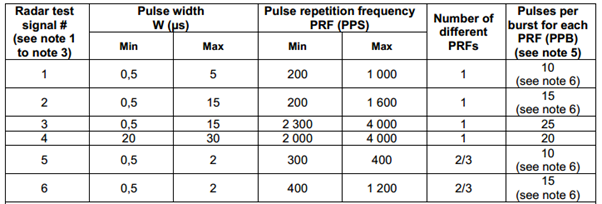
(Credit: Excerpt from ETSI standard: EN 301 893 V2.1.1)
The diagram below shows a single burst pattern that may be used to test WLAN devices:
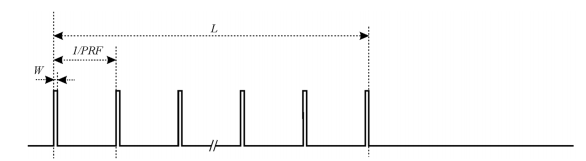
(Credit: Extract from ETSI standard: EN 301 893 V2.1.i)
There is little doubt, that compared to the detection of well-structured, longer duration 802.eleven frames, WLAN equipment has been set quite a claiming in reliably detecting radar signals (which tin lead to annoying side-effects, discussed later).
Are All 5GHz Channels Subject to DFS?
No, not all channels in the 5GHz band are subject to DFS. The channels that are exempt vary from land to country, equally dictated by local regulations. In the United kingdom/EU, channels 36, xl, 44 and 48 are not subject to DFS. However, all remaining channels are subject area to DFS. In the USA, channels 36 - 48, together with 149 - 165 are exempt from DFS performance, with all remaining channels requiring DFS operation. (Check your local spectrum regulation authority for the latest information for your country).
Channels that are not subject to DFS operate without having to perform any radar checks. Therefore, they are not subject to any disruptions from local radar equipment (or any other sources RF interference that may cause false-positive detection)
What Happens To Clients During a DFS Event?
Devices that are subject field to DFS checks are divided in to 2 roles: master and slave. Information technology is the role of the master device to suggest slave devices when radar has been detected and that a aqueduct shutdown is required. In WLANs, the access bespeak is usually the master device, with the associated clients designated every bit slaves.
Once radar is detected, it is the duty of the master device to advise the slaves that a channel modify is imminent via a aqueduct switch announcement message. This message should advise slaves (clients) which channel the AP intends to move to.
What Is The Bear on on Client Applications During a DFS Event?
Once a radar point has been detected, the impact on clients due to the required aqueduct change is "variable".
WLAN systems may or may not send a channel switch announcement (CSA). If no announcement is received by a client (or is lost in transit), then the client will be forced to go through its probing process to discover a suitable BSSID with which to associate. Depending on the network configuration and client capabilities (e.g. 802.11k/v/r), the time to re-associate with the network volition vary. Note that even if a CSA is received, a client may still cull to go through its own AP discovery process based on probing or 80.211k information information technology has received.
Once the motion to a new aqueduct has been completed, there will then exist the usual delays in the resumption of awarding data menstruation due to processes such network access authentication and DHCP exchanges – these will once more vary with network configuration.
Whatever the configuration of the WLAN and client capabilities, the move to a new channel will not be without some connectivity impact. This impact may be unnoticeable for users who are using non-real-fourth dimension applications (due east.g. postal service, web browsing), but will certainly have an bear on on latency sensitive, real-fourth dimension applications (e.g. voice, video).
What Causes False DFS Detection?
Although DFS is, in theory, a great idea to protect systems that share the 5GHz spectrum, it has a major pitfall: false positives.
Detecting a radar signal signature is quite a catchy business. Due to the variety of radar signatures that may be detected, together with the curt-duration nature of radar signals, fake positive events may be quite frequent in some WLAN systems.
A false positive means that an AP is fooled into thinking that a radar indicate is present by a non-radar RF signal. This causes a channel change, when one is non needed. This obviously leads to un-necessary WLAN disruption, that has varying impact on clients, depending on the applications in-use.
Theories around the exact cause of faux positive events seem to be numerous, depending on who you speak with. I've heard the following possible causes cited:
- Transient conditions due to high densities of clients
- Bad client drivers causing brusk term RF spikes
- Co-aqueduct interference from distant APs on the same channel
- Local non-Wi-Fi equipment interference
Whatever the cause, the false positives observed more often than not tend to be observed during times of increased user presence (i.due east. they seem more likely during "part hours" as user numbers & activity increase).
How Do I Detect DFS Events?
To observe out if your network is being impacted by DFS events, you need to check the trap logs or syslog messages from your wireless system.
All systems should report when a radar hit has been detected. This will generally be recorded in the logs of the AP, wireless controller or direction system. Ofttimes this volition be forwarded as an SNMP trap to a management system or perhaps as a syslog message to your logging server.
If you lot have log assay and trending capabilities, it is well worth monitoring radar events to look for patterns of behaviour (due east.g. particular sites, event times and channels)
What Practise "Real" DFS Events Look Like?
You might be scratching your head at this signal wondering how you lot can tell the departure betwixt "real" DFS events and false positives.
In my experience, DFS events caused by genuine radar systems tend to be limited to a specific subset of channels on the 5GHz ring. For instance, you lot may check your organization logs and observe that in a particular building, only channels 116 and 120 (for instance) are reporting DFS events (i.e. radar hits). Also, these tend to be at a consistent rata throughout the day.
In contrast, false positives tend to be spread beyond a very wide portion of the 5GHz band and will vary in frequency throughout the day. They likewise mostly fall to very low levels outside of office hours and at weekend (depending on the working patterns of your particular establishment).
How Can I Mitigate DFS Events on a Wi-Fi Network?
At that place are a few options available to try to mitigate the bear upon of DFS events on a WLAN:
- For genuine radar events that are impacting a subset of the 5GHz band, simply exclude the impacted channels from any channel planning. If using static channel planning, then avert using afflicted channels. If using an auto-RF machinery (i.e. automated channel planning), so exclude the afflicted channels from those available to the configuration of the auto-RF process
- Trying to mitigate faux positives is a little more tricky. Options include:
- If you accept sufficient non-DFS channels, do non use DFS channels at all in channel planning. This choice is very much dependent on WLAN chapters requirements and the local regulatory domain in which the network operates
- Work with the WLAN vendor to find out if they accept a more recent version of operating lawmaking that is less susceptible to DFS false positives. I have seen this approach used many times, with varying degrees of success
- Work with a vendor or VAR to attempt to identify any local sources of interference that may create imitation positives. Occasionally, information technology may be possible to identify a item client blazon or item of non-Wi-Fi equipment that is causing fake positives, If you have a support contract, assistance from a suitably qualified WLAN expert armed with a spectrum analyser and able to perform log analysis may be invaluable in tracking downwardly offenders.
- If y'all vendor is unable to fix the issue, information technology may exist worth trying an alternative vendor. Though this may seem farthermost, I have seen huge variations betwixt vendors and their susceptibility to DFS false positives. A limited-telescopic proof of concept costs little to deploy and can provide astonishing leverage with your existing vendor…
What volition be the impact of DFS on my Wi-Fi Network?
The impact of DFS events on your network (both "real" & fake positive) will ever be the same: a DFS issue is detected and an AP will modify channels. This volition also cause the associated wireless clients to change channels.
The actual impact on the end-user will vary depending on what they are doing on their client.
Many applications that aren't latency sensitive will simply go along with little obvious bear on on service. If a user is browsing the spider web, sending email or fifty-fifty streaming a video file (assuming some buffering), they will generally not notice their client jump between channels as their associated AP changes channels. This assumes your WLAN is correctly designed so that clients have viable culling APs bachelor.
If clients are using real-time, latency sensitive applications, so they are much more likely to discover some sort of negative touch on. The transition to a new channel is probable to be quite long (in WLAN terms). It volition vary depending on the required operations (east.g. channel probing, 802.1X exchanges, DHCP exchanges etc.), only will more often than not be long enough to have an bear upon of existent-time applications such a vocalization and real-fourth dimension video. The use of enhanced WLAN features such as 802.11r/k may help to ensure that clients can significantly speed upwardly the AP selection and roaming process.
These considerations provide a useful indication as to whether DFS events are going to provide problems on your WLAN and whether you lot should consider the impact of DFS on your wireless network.
Decision
In many Enterprise wireless WLANs, in that location will generally be a requirement to apply equally many unique 5GHz channels every bit possible. This provides opportunities to mitigate co-channel interference and increase capacity through the employ of aqueduct bonding (if required).
However, understanding and verifying the bear on (if whatever) of radar detection is important to ensure the requirements of our WLAN pattern are not compromised.
References
Here are another corking sources of data you might similar to look at for more data about DFS:
- Designing with DFS Channels (Devin Akin Webinar): https://www.brighttalk.com/webcast/5522/279895/designing-with-dfs-channels
- A Practical Introduction to DFS (Blog post): https://www.adriangranados.com/blog/practical-intro-dfs
- Dynamic Frequency Selection Parts 1 to 3 (Jennifer Jabbusch articles) : https://www.networkcomputing.com/wireless/dynamic-frequency-selection-why-its-disquisitional-80211ac/1439499958
- (ETSI) EN 301 893 standard: http://www.etsi.org/deliver/etsi_en/301800_301899/301893/01.07.01_60/en_301893v010701p.pdf
- Wikipedia WLAN Channels: https://en.wikipedia.org/wiki/List_of_WLAN_channels
- UK 5GHz channel summary (WiFiNigel PDF): http://bowdennetworks.co.uk/downloads/5GHz%20Spectrum%20Usage%20UK%20-%202017%20-%20v1.pdf
schumanndreff1937.blogspot.com
Source: https://wifinigel.blogspot.com/2018/05/the-5ghz-problem-for-wi-fi-networks-dfs.html
Post a Comment for "Can Again Fire Tv Connect to a 5g Network"