Fats Domino Here He Comes Again
| Fats Domino | |
|---|---|
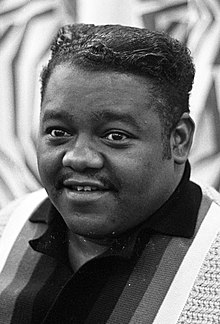 Domino in 1962 | |
| Born | Antoine Dominique Domino Jr. (1928-02-26)Feb 26, 1928 New Orleans, Louisiana, U.Due south. |
| Died | Oct 24, 2017(2017-ten-24) (aged 89) Harvey, Louisiana, U.S. |
| Other names |
|
| Occupation |
|
| Years active | 1942–2017 |
| Spouse(due south) | Rosemary Hall (m. 1947; died 2008) |
| Children | 8 |
| Musical career | |
| Genres |
|
| Instruments |
|
| Labels |
|
Antoine Dominique Domino Jr. [1] (February 26, 1928 – October 24, 2017), known every bit Fats Domino, was an American pianist and singer-songwriter. One of the pioneers of rock and roll music, Domino sold more than 65 million records.[ii] Born in New Orleans to a French Creole family, Domino signed to Imperial Records in 1949. His first single "The Fatty Human being" is cited by some historians as the outset rock and roll single and the first to sell more than than one million copies.[3] [4] Domino connected to piece of work with the song's co-writer Dave Bartholomew, contributing his distinctive rolling piano fashion to Lloyd Toll's "Lawdy Miss Clawdy" (1952) and scoring a string of mainstream hits beginning with "Ain't That a Shame" (1955). Between 1955 and 1960, he had 11 Top ten United states of america pop hits.[five] Past 1955, v of his records had sold more than a million copies, beingness certified gold.[6]
Domino was shy and small-scale by nature but made a significant contribution to the rock and coil genre.[7] Elvis Presley declared Domino a "huge influence on me when I started out" and described him as "the real king of stone 'due north' roll". The Beatles were also heavily influenced by Domino.[viii] [9] The creative person himself did not define his work as stone and roll, saying of the genre "Information technology wasn't annihilation simply the aforementioned rhythm and blues I'd been playing down in New Orleans". 4 of Domino's records were named to the Grammy Hall of Fame for their significance: "Blueberry Hill", "Ain't That A Shame", "Walking to New Orleans" and "The Fatty Man".[3] He was inducted into the Rock and Curlicue Hall of Fame as part of its outset group of inductees in 1986. The Associated Printing estimates that during his career, Domino "sold more than 110 million records".[ten]
Biography [edit]
Early life and education [edit]
Antoine Domino Jr. was born and raised in New Orleans, Louisiana, the youngest of eight children born to Antoine Caliste Domino (1879–1964) and Marie-Donatille Gros (1886–1971). The Domino family was of French Creole groundwork, and Louisiana Creole was his beginning language.[11] Similar most such families, the Dominos were Catholic.[12]
Antoine was born at abode with the assistance of his grandmother, a midwife. His name was initially misspelled as Anthony on his birth certificate.[thirteen] His family unit had recently arrived in the Lower Ninth Ward from Vacherie, Louisiana.[fourteen] His father was a office-fourth dimension violin actor who worked at a racetrack.[15] [xvi]
He attended the Louis B. Macarty School, leaving to get-go work as a helper to an water ice delivery man.[17] Domino learned to play the piano in virtually 1938 from his brother-in-police,[eighteen] the jazz guitarist Harrison Verrett.[6] [xix]
Early career (1940s) [edit]
By age xiv, Domino was performing in New Orleans confined.[v] [20] In 1947, Baton Diamond, a New Orleans bandleader, accepted an invitation to hear the young pianist perform at a backyard barbecue. Domino played well enough that Diamond asked him to join his ring, the Solid Senders, at the Hideaway Club in New Orleans, where he would earn $3 a week playing the pianoforte.[16] Diamond nicknamed him "Fats", because Domino reminded him of the renowned pianists Fats Waller and Fats Pichon, only also because of his large appetite.[21] [5]
Recordings for Imperial Records (1949–1962) [edit]
Domino was signed to the Regal Records characterization in 1949 past possessor Lew Chudd, to exist paid royalties based on sales instead of a fee for each song. He and producer Dave Bartholomew wrote "The Fat Human being", a toned down version of a vocal about drug addicts called "Junker Blues"; the record had sold a meg copies by 1951.[17] Featuring a rolling pianoforte and Domino vocalizing "wah-wah" over a strong backbeat, "The Fat Man" is widely considered the first rock-and-curlicue record to attain this level of sales.[22] [23] In 2015, the song would enter the Grammy Hall of Fame.[eighteen]
Domino released a series of hit songs with Bartholomew (also the co-author of many of the songs), the saxophonists Herbert Hardesty and Alvin "Red" Tyler, the bassist Billy Diamond and afterwards Frank Fields, and the drummers Earl Palmer and Smokey Johnson. Other notable and long-continuing musicians in Domino'south band were the saxophonists Reggie Houston,[24] Lee Allen,[25] and Fred Kemp, Domino's trusted bandleader.[26]

While Domino'southward ain recordings were done for Imperial, he sometimes sat in during that time as a session musician on recordings by other artists for other record labels. Domino's rolling piano triplets provided the memorable instrumental introduction for Lloyd Cost'south first hit, "Lawdy Miss Clawdy", recorded for Specialty Records on March thirteen, 1952, at Cosimo Matassa'due south J&M Studios in New Orleans (where Domino himself had earlier recorded "The Fat Man" and other songs). Dave Bartholomew was producing Price'south record, which also featured familiar Domino collaborators Hardesty, Fields and Palmer as sidemen, and he asked Domino to play the piano part, replacing the original session pianist.[27]
Domino crossed into the popular mainstream with "Ain't That a Shame" (mislabeled as "Ain't It a Shame") which reached the Height X. This was the first of his records to announced on the Billboard pop singles chart (on July sixteen, 1955), with the debut at number fourteen.[28] A milder cover version by Pat Boone reached number 1,[29] having received wider radio airplay in an era of racial segregation. In 1955, Domino was said to be earning $10,000 a week while touring, according to a report in the memoir of artist Chuck Berry. Domino eventually had 37 Meridian xl singles, simply none made it to number 1 on the Pop nautical chart.[5]
Domino'due south debut anthology contained several of his recent hits and earlier blues tracks that had not been released as singles, and was issued on the Royal label (catalogue number 9009) in November 1955, and was reissued as Rock and Rollin' with Fats Domino.[30] The reissue reached number 17 on the Billboard Pop Albums chart.[31]
His 1956 recording of "Huckleberry Hill", a 1940 song by Vincent Rose, Al Lewis and Larry Stock (which had previously been recorded by Gene Autry, Louis Armstrong and others), reached number ii on the Billboard Juke Box nautical chart for two weeks[32] and was number 1 on the R&B chart for 11 weeks. It was his biggest hitting,[29] selling more v 1000000 copies worldwide in 1956 and 1957. The song was subsequently recorded past Elvis Presley, Little Richard, and Led Zeppelin.[33] Some 32 years subsequently, the vocal would enter the Grammy Hall of Fame.[18]
Domino had farther hitting singles between 1956 and 1959, including "When My Dreamboat Comes Home" (Pop number 14), "I'm Walkin'" (Popular number four), "Valley of Tears" (Pop number 8), "It'southward You I Dear" (Pop number 6), "Whole Lotta Lovin'" (Pop number 6), "I Desire to Walk You Home" (Pop number 8), and "Exist My Guest" (Pop number 8).[34] In 1957, Domino maintained "What they call rock 'northward' roll now is rhythm and dejection. I've been playing information technology for 15 years in New Orleans".[35] [8]
Domino appeared in ii films released in 1956: Shake, Rattle & Stone! [36] and The Girl Can't Help It.[37] On Dec 18, 1957, his hit recording of "The Big Beat" was featured on Dick Clark's American Bandstand. He was also featured in a picture of the same name.[38]
On November ii, 1956, a anarchism bankrupt out at a Domino concert in Fayetteville, North Carolina. The law used tear gas to break upwards the unruly crowd. Domino jumped out a window to avoid the melee; he and 2 members of his band were slightly injured.[39] During his career, 4 major riots occurred at his concerts, "partly because of integration", according to his biographer Rick Coleman. "But too the fact they had alcohol at these shows. So they were mixing alcohol, plus dancing, plus the races together for the offset time in a lot of these places."[40] In Nov 1957, Domino appeared on The Ed Sullivan Show; no disturbance accompanied this performance.[41]
In the aforementioned year, the article "King of Rock 'n' Ringlet" in Ebony magazine featured Domino who said he was on the road 340 days a year, upwardly to $two,500 per evening, and grossing over $500,000; Domino besides told readers that he owned 50 suits, 100 pairs of shoes and a $one,500 diamond horseshoe stick pin.[32]
Domino had a steady series of hits for Purple through early 1962, including "Walking to New Orleans" (1960, Pop number 6), co-written past Bobby Charles, and "My Girl Josephine" (Pop number xiv) in the same year. He toured Europe in 1962 and met the Beatles who would later cite Domino as an inspiration.[42] Later returning, he played the first of his many stands in Las Vegas.[xviii]
Purple Records was sold in early on 1963,[43] and Domino left the label. "I stuck with them until they sold out," he said in 1979. In all, he recorded over 60 singles for Imperial, placing 40 songs in the top 10 on the R&B chart and eleven in the tiptop 10 on the Popular chart, twenty-vii of which were double-sided hits.[44]
Recordings after leaving Imperial (1963–1970s) [edit]

Domino moved to ABC-Paramount Records in 1963. The characterization dictated that he record in Nashville, Tennessee, rather than New Orleans. He was assigned a new producer (Felton Jarvis) and a new arranger (Bill Justis). Domino's long-term collaboration with the producer, arranger, and frequent co-writer Dave Bartholomew, who oversaw most all of his Imperial hits,[45] was seemingly at an end. Jarvis and Justis changed the Domino audio somewhat, notably past adding the backing of a countrypolitan-style vocal chorus to most of his new recordings. He released 11 singles for ABC-Paramount, several which hit the Top 100 merely just one time entering the Superlative twoscore ("Red Sails in the Dusk", 1963). By the end of 1964 the British Invasion had changed the tastes of the record-buying public, and Domino'southward chart run was over.[46]
Despite the lack of chart success, Domino continued to record steadily until nigh 1970, leaving ABC-Paramount in mid-1965 and recording for Mercury Records, where he delivered a live anthology and two singles. A studio anthology was planned just stalled with but iv tracks recorded. Dave Bartholomew's minor Broadmoor label (reuniting with Bartholomew along the fashion), featured many gimmicky Soul infused sides and a few single releases but an album was not released overseas until 1971 to fulfill his Reprise Records contract. He shifted to that label after Broadmoor and had a Top 100 single, a cover of the Beatles' "Lady Madonna".[17]
Domino appeared in the Monkees' television special 33⅓ Revolutions per Monkee in 1969. In 1971, he opened for Ike & Tina Turner at Carnegie Hall.[47] He continued to be popular every bit a performer for several decades. He fabricated a cameo appearance in Clint Eastwood'south movie Whatever Which Way You Can, filmed in 1979 and released in 1980, singing the state song "Whiskey Sky", which afterwards became a minor hit.[xviii] [48] His life and career were showcased in Joe Lauro's 2015 documentary The Large Beat: Fats Domino and the Nascency of Rock 'due north' Whorl.[49]
After career (1980s–2005) [edit]
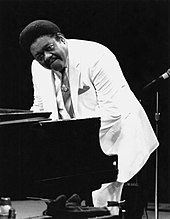
Domino performing in New York in the 1980s
In 1986, Domino was one of the first musicians to exist inducted into the Rock and Scroll Hall of Fame.[50] [17] He besides received the Grammy Lifetime Achievement Award in 1987.[2] Domino's last album for a major characterization, Christmas Is a Special Twenty-four hours, was released in 1993.[51]
Domino lived in a mansion in a predominantly working-class neighborhood in the Lower Ninth Ward, where he was a familiar sight in his bright pink Cadillac automobile. He made yearly appearances at the New Orleans Jazz & Heritage Festival and other local events.
His last tour was in Europe, for three weeks in 1995.[52] After being ill while on tour, Domino decided he would no longer leave the New Orleans expanse, having a comfortable income from royalty payments and a dislike of touring and claiming he could non get whatever food that he liked anywhere else.[53] In the same year, he received the Rhythm & Blues Foundation'south Ray Charles Lifetime Achievement Award.[18]
In 1998, President Bill Clinton awarded him the National Medal of Arts.[54] [55] Domino declined an invitation to perform at the White House.[53]
In 2004, Rolling Rock magazine ranked him number 25 on its list of the "100 Greatest Artists of All Time" in an essay written by Dr. John.[56]
Domino and Hurricane Katrina [edit]

Graffiti on Domino's abode from the time he was rumored dead in the aftermath of Hurricane Katrina (2005)
As Hurricane Katrina approached New Orleans in August 2005, Domino chose to stay at domicile with his family, partly because his wife, Rosemary, was in poor health. His business firm was in an area that was heavily flooded.

Domino's role, June 2007
Domino was rumored to have died,[57] and his abode was vandalized when someone spray-painted the message "RIP Fats. You will be missed". On September 1, the talent agent Al Embry announced that he had non heard from Domino since earlier the hurricane struck. Subsequently that twenty-four hour period, CNN reported that Domino had been rescued by a Coast Guard helicopter. Until then, fifty-fifty family members had not heard from him since earlier the storm.[58] Embry confirmed that Domino and his family unit had been rescued. The family was then taken to a shelter in Baton Rouge, after which they were picked upwardly by JaMarcus Russell, the starting quarterback of the Louisiana State University football game team, and the beau of Domino's granddaughter. He permit the family stay in his apartment. The Washington Post reported that on September two, they had left Russell's apartment after sleeping three nights on the couch. "We've lost everything," Domino said, according to the Post.[59]
By January 2006, piece of work to gut and repair Domino's home and office had begun (see Reconstruction of New Orleans). In the meantime, the Domino family resided in Harvey, Louisiana.[60]
President George W. Bush made a personal visit and replaced the National Medal of Arts that President Bill Clinton had previously awarded Domino.[61] The gilt records were replaced by the RIAA and Capitol Records, which owned the Imperial Records catalogue.[62]
Later life [edit]
Domino was scheduled to perform at the 2006 Jazz & Heritage Festival in New Orleans. Yet, he was suffering from feet and was forced to abolish the performance,[63] but he did appear to offer the audience an on-stage greeting.[64]
In 2006 Domino'south album Live and Kickin' was released to benefit the Tipitina's Foundation, which supports indigent local musicians and helps preserve the New Orleans sound.[65] [66] The album consists of unreleased recordings from the 1990s[67] and received neat critical acclaim.[68]
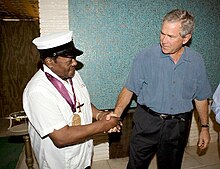
Domino (age 78) with the National Medal of Arts replaced by President George W. Bush on August 29, 2006, afterwards the original medal, awarded to him by President Beak Clinton, was lost in the floodwaters of Hurricane Katrina.
On January 12, 2007, Domino was honored with OffBeat magazine's Lifetime Achievement Award at the annual All-time of the Trounce Awards, held at the House of Blues in New Orleans. New Orleans Mayor Ray Nagin declared the 24-hour interval "Fats Domino Day in New Orleans" and presented him with a signed declaration.[69] Domino returned to stage on May 19, 2007, at Tipitina'south at New Orleans, performing to a total business firm. This was his last public performance.[18] The concert was recorded for a 2008 TV presentation entitled Fats Domino: Walkin' Back to New Orleans.[63] This was a fund-raising concert, featuring a number of artists. Domino donated his fee to the cause. Later that year, a Vanguard record was released, Goin' Home: A Tribute to Fats Domino featuring his songs every bit recorded by Elton John, Neil Young, Tom Niggling, Robert Plant, Willie Nelson, Norah Jones, Lenny Kravitz, and Lucinda Williams.[5] A portion of the proceeds was to exist used past the Foundation to assistance restore Domino's publishing office which had been damaged past the hurricane.[70]
In September 2007, Domino was inducted into the Louisiana Music Hall of Fame.[71] [72]
In May 2009, Domino made an unexpected appearance in the audience for the Domino Consequence, a concert featuring Picayune Richard and other artists, aimed at raising funds to help rebuild schools and playgrounds damaged by Hurricane Katrina.[73]
In October 2012, Domino was featured in season 3 of the goggle box serial Treme, playing himself.[18] On August 21, 2016, Domino was inducted into the National Rhythm and Dejection Hall of Fame. The ceremony was held in Detroit, Michigan. The other inductees were Dionne Warwick, Cathy Hughes, Smokey Robinson, Prince, and the Supremes. He had received the Rhythm & Blues Foundation'due south Ray Charles Lifetime Achievement Laurels in 1995. His song "The Fat Homo" entered the Grammy Hall of Fame in 2015.[74]
Decease [edit]
Domino died on October 24, 2017, at his home in Harvey, Louisiana, at the age of 89, from natural causes, co-ordinate to the coroner'due south function.[75] [76] [77]
Influence and legacy [edit]
Domino was one of the biggest stars of rock and roll in the 1950s, merely he was not convinced that this was a new genre. In 1957, Domino said: "What they telephone call stone 'n' curl now is rhythm and blues. I've been playing it for 15 years in New Orleans".[78] According to Rolling Stone, "this is a valid statement ... all Fifties rockers, black and white, country born and metropolis bred, were fundamentally influenced past R&B, the blackness pop music of the late Forties and early Fifties".[79]
He was among the showtime R&B artists to gain popularity with white audiences. His biographer Rick Coleman argues that Domino's records and tours with rock-and-whorl shows in that decade, bringing together black and white youths in a shared appreciation of his music, was a factor in the breakdown of racial segregation in the United States.[80] The artist himself did not define his work as rock and roll, saying, "It wasn't anything but the aforementioned rhythm and blues I'd been playin' downwardly in New Orleans."[81]
Both John Lennon and Paul McCartney recorded Domino songs. According to some reports, McCartney wrote the Beatles vocal "Lady Madonna" in emulation of Domino's fashion,[82] combining information technology with a nod to Humphrey Lyttelton's 1956 hit "Bad Penny Dejection". Domino also recorded the vocal in 1968.[5] Domino returned to the "Hot 100" chart for the final time in 1968, with his recording of "Lady Madonna".[16] That recording, as well as covers of 2 other songs past the Beatles, appeared on his Reprise album Fats Is Back, produced by Richard Perry and with several hits recorded by a band that included the New Orleans pianist James Booker.[83]
Domino was present in the audition of 2,200 people at Elvis Presley'southward start concert at the Las Vegas Hilton on July 31, 1969. At a press briefing after the show, when a journalist referred to Presley as "The King", Presley gestured toward Domino, who was taking in the scene. "No," Presley said, "that's the real rex of rock and ringlet."[84] Presley made a subsequent comment, "rock 'n' roll was hither a long time before I came along. Permit's face it: I tin can't sing like Fats Domino can. I know that" and added that Domino was "a huge influence on me when I started out".[85]
About a photo made of him and Elvis together, Domino said: "Elvis told me he flopped the starting time fourth dimension he came to Las Vegas. I loved his music. He could sing annihilation ... I'thou glad we took this movie." (Fats Domino (2002). "Music Pioneer Fats Domino Talks Most Elvis." Retrieved from "The states Today." December 10, 2002.)
Domino received a Grammy Lifetime Accomplishment Accolade in 1987.[iii]
John Lennon covered Domino'due south composition "Ain't That a Shame" on his 1975 album "Stone 'n' Roll," his tribute to the musicians who had influenced him.
American band Cheap Fox recorded "Ain't That a Shame" on their 1978 live album Cheap Trick at Budokan and released it as the 2d unmarried from the album. It reached 35 of the Billboard Hot 100. Reportedly, this was Domino's favorite cover.[86] It remains a staple of their live performances, including at their 25th Anniversary concert (which was recorded as the album and DVD Silvery) and at their induction into the Rock and Roll Hall of Fame in 2016.[87]
The Jamaican reggae artist Yellowman covered many songs by Domino, including "Be My Guest" and "Huckleberry Hill."[88]
Jah Wobble, a post-punk bassist best known for his work with Johnny Rotten, released a solo recording of "Blueberry Loma".[89]
The Jamaican ska ring Justin Hinds and the Dominoes, formed in the 1960s, was named after Domino, Hinds'south favorite vocalizer.[ninety]
In 2007, various artists came together for a tribute to Domino, recording a alive session containing only his songs. Musicians performing on the anthology, Goin' Dwelling: A Tribute to Fats Domino, included Paul McCartney, Norah Jones, Willie Nelson, Neil Young, and Elton John.[91]
Co-ordinate to Richie Unterberger, writing for AllMusic, Domino was one of the almost consistent artists of early rock music, the best-selling African-American rock-and-whorl star of the 1950s, and the near popular singer of the "archetype" New Orleans rhythm and blues style. His 1000000-selling debut single, "The Fatty Man" (1949), is one of many that have been cited as the first rock and curl record.[92] Robert Christgau wrote that Domino was "the well-nigh widely liked rock and roller of the '50s" and remarked on his influence:
Warm and unthreatening even by the intensely fraternal standards of New Orleans, he'southward remembered with fond condescension as significantly less innovative than his uncommercial compatriots Professor Longhair and James Booker. But though his bouncy boogie-woogie piano and easy Creole gait were generically 9th Ward, they defined a pop-friendly second-line beat that nobody knew was there before he and Dave Bartholomew created 'The Fat Human being' in 1949. In curt, this shy, deferential, uncharismatic man invented New Orleans stone and roll.[93]
Domino's rhythm, accentuating the offbeat, as in the vocal "Exist My Guest", was an influence on ska music.[94]
Personal life [edit]
Domino was married to Rosemary Domino (née Hall) from 1947 until her death in 2008; the couple had viii children: Antoine III (1950-2015), Anatole, Andre (1952-1997), Antonio, Antoinette, Andrea, Anola, and Adonica.[7] [95]
Even after his success he continued to live in his old neighborhood, the Lower 9th Ward, until afterward Hurricane Katrina, when he moved to a suburb of New Orleans.[53] [96]
Discography [edit]
- Fats Domino discography
- List of songs recorded by Fats Domino
Studio albums [edit]
- Rock and Rollin' with Fats Domino (1956)
- Fats Domino Rock and Rollin' (1956)
- This is Fats Domino! (1956)
- Here Stands Fats Domino (1957)
- This Is Fats (1957)
- The Fabulous Mr. D (1958)
- Let's Play Fats Domino (1959)
- Fats Domino Sings One thousand thousand Tape Hits (1960)
- ...A Lot Of Dominos! (1960)
- I Miss You Then (1961)
- Permit The Four Winds Blow (1961)
- What A Party! (1961)
- Twistin' The Stomp (1962)
- Only Domino (1962)
- Walking To New Orleans (1963)
- Let's Dance With Domino (1963)
- Here He Comes Again! (1963)
- Here Comes... Fats Domino (1963)
- Fats On Fire (1964)
- Getaway With Fats Domino (1965)
- The Best Of Fats Domino! (1966)
- Fats Is Back (1968)
- Fats (1971)
- Sleeping On The Job (1979)
- Christmas Is A Special Mean solar day (1993)
- Alive and Kickin' (2006)
References [edit]
- ^ Pareles, Jon; William Grimes (October 25, 2017). "Fats Domino, Early Rock 'n' Roller With a Boogie-Woogie Piano, Is Dead at 89". The New York Times . Retrieved June eleven, 2018.
- ^ a b O'Connor, Roisin (October 25, 2017). "Fats Domino dead: Rock and roll legend dies, aged 89". The Independent . Retrieved October 26, 2017.
- ^ a b c "Fats Domino". Biography.com . Retrieved June 10, 2021.
- ^ "Fats Domino, 1928–2017". Grammy.com. Oct 25, 2017. Retrieved June 10, 2021.
- ^ a b c d east f Browne, David (October 25, 2017). "Fats Domino, Rock and Roll Pioneer, Dead at 89". Rolling Stone . Retrieved October 26, 2017.
- ^ a b Friedlander, Paul (2006). Rock And Roll: A Social History. Bedrock, Colorado: Westview Press. pp. 28–32.
- ^ a b Light, Alan (February 23, 2016). "'The Big Beat' Celebrates Fats Domino, Rock'south Reclusive Giant". The New York Times . Retrieved Oct 26, 2017.
- ^ a b Leight, Elias (October 26, 2017). "Paul McCartney Remembers 'Truly Magnificent' Fats Domino". Rollingstone.com . Retrieved June 10, 2021.
- ^ Manning, Evan (October 26, 2017). "Remembering Fats Domino: The Beatles, Elvis Presley and the existent king of rock 'northward' ringlet". Nationalpost.com . Retrieved June 10, 2021.
- ^ "Fats Domino dead: Rock n' gyre pioneer expressionless at 89". Globalnews.ca . Retrieved June 10, 2021.
- ^ "Fats Domino". Biography.com . Retrieved October 29, 2017.
- ^ Vera, Billy. "Fats Domino" (PDF). Dejection and Rhythm . Retrieved July iv, 2021.
- ^ Hawkeye, Bob; LeBlanc, Eric S. (2013). Dejection: A Regional Experience. Santa Barbara, California: Praeger. p. 445. ISBN9780313344237.
- ^ Sublette, Ned (2009). The Yr Earlier the Flood. Chicago: Lawrence Loma Books. pp. 56–60.
- ^ "Rock 'due north' Roll Legend Fats Domino Dies at 89". biography.com. Archived from the original on October 26, 2017. Retrieved October 26, 2017.
- ^ a b c Otfinoski, Steven (2010). African Americans in the Performing Arts. Infobase Publishing. p. threescore. ISBN978-1438128559.
- ^ a b c d Pareles, Jon; Grimes, William (October 25, 2017). "Fats Domino, Early Rock 'n' Roller With a Boogie-Woogie Piano, Is Expressionless at 89". The New York Times . Retrieved October 26, 2017.
- ^ a b c d e f g h Coleman, Rick (Jan 26, 2016). "Fats Domino: Timeline of His Life, Hits and Career Highlights". Pbs.org.
- ^ Coleman, Rick (2006). Blue Monday: Fats Domino and the Lost Dawn of Rock 'n' Ringlet. Boston: Da Capo Printing. pg. 19; ISBN 9780306815317
- ^ Hurtt, Michael (June one, 2004). "BackTalk: Fats Domino (Interview)". OffBeat Magazine . Retrieved Oct 26, 2017.
- ^ Coleman (2006). pp. 26–28.
- ^ Friedlander, Paul (2006). Rock and Curl: A Social History. Boulder, Colorado: Westview Press. p. 28.
- ^ Adams, Owen (May 14, 2007). "How Fats Domino invented rock'n'roll". The Guardian . Retrieved Oct 25, 2017.
- ^ "Reggie Houston – Bio & Printing Photos". reggiehouston.com . Retrieved October 26, 2017.
- ^ "Masters of Louisiana Music: Lee Allen – OffBeat Magazine". Retrieved October 26, 2017.
- ^ "Archetype Music Hits and Artists – I Oldies Music Shop". iOldies Music Store . Retrieved Oct 26, 2017.
- ^ Coleman (2006). pp. 72–74.
- ^ "Fats Domino's Biggest Billboard Hits: From 'Ain't That a Shame' to 'Blueberry Hill' & More than". Billboard . Retrieved October 29, 2017.
- ^ a b "Show half-dozen – Hail, Hail, Rock 'n' Roll: The Rock Revolution Gets Underway. [Role 2]: UNT Digital Library". Retrieved October 25, 2017.
- ^ Strong, Martin C. (2004). The Great Stone Discography: Consummate Discographies Listing Every Rails Recorded by More Than one,200 Artists. Canongate U.Due south. p. 434. ISBN1841956155.
- ^ Rock and Rollin' with Fats Domino Billboard Albums at AllMusic. Retrieved October 26, 2017.
- ^ a b Coleman, Rick (February 17, 2016). "Book Excerpt: Blue Monday. Fats Domino and the Lost Dawn of Stone 'N' Roll". Pbs.org.
- ^ "5 of Fats Domino's virtually influential songs". The Independent. October 25, 2017. Retrieved October 29, 2017.
- ^ "Fats Domino Chart History". Billboard . Retrieved October 26, 2017.
- ^ Andrews, Travis M. (Oct 26, 2017). "Some declared Fats Domino dead during Katrina. He lived to laugh well-nigh it". The Washington Post.
- ^ "Milkshake, Rattle & Rock". IMDb.com. Apr 5, 1957. Retrieved November 1, 2006.
- ^ "The Girl Can't Help Information technology". IMDB.com. December 1956. Retrieved November 1, 2006.
- ^ Coleman, Rick (January 26, 2016). "Fats Domino: Timeline of His Life, Hits and Career Highlights". PBS. Retrieved October 26, 2017.
- ^ "Oldies Music". About.com. Archived from the original on October three, 2010. Retrieved April 26, 2010.
- ^ Robinson, Jennifer. "AMERICAN MASTERS: Fats Domino And The Birth Of Stone 'n' Whorl". kpbs.org. Retrieved October 26, 2017.
- ^ Gulla, Bob (2008). Icons of R & B and soul: an encyclopedia of the artists who revolutionized rhythm. Westport, Conn.: Greenwood Printing. p. 61. ISBN9780313340444. OCLC 230807722.
- ^ Pareles, Jon; Grimes, William. "Fats Domino, Early on Stone 'n' Roller With a Boogie-Woogie Pianoforte, Is Dead at 89". The New York Times . Retrieved October 26, 2017.
- ^ "Fats Domino". Rock & Curl Hall of Fame . Retrieved Oct 26, 2017.
- ^ "Fats Domino The Royal Years". uncamarvy.com. Retrieved October 26, 2017.
- ^ "Fats Domino". Rock & Coil Hall of Fame . Retrieved October 29, 2017.
- ^ Erlewine, Stephen Thomas. "Fats is Back – Fats Domino". Allmusic . Retrieved October 26, 2017.
- ^ "Ike & Tina Turner, Fats Domino". Billboard: 20. Apr 17, 1971.
- ^ Coleman, Rick (February one, 1998). "Seven Decades Of Fats Domino". OffBeat . Retrieved Oct 25, 2017.
- ^ "'The Large Beat: Fats Domino and the Birth of Rock 'n' Whorl': Motion-picture show Review". The Hollywood Reporter. February 20, 2015. Retrieved Oct 26, 2017.
- ^ Palmer, Robert (January 25, 1986). "Waldorf Rock 'n' Rolls with Hall of Fame stars". The New York Times . Retrieved October 26, 2017.
- ^ "Rock Pioneer Fats Domino Dies at 89". Billboard . Retrieved October 29, 2017.
- ^ Spera, Keith (2011). Groove Interrupted. New York: St Martin'southward Printing. pp. 88–107.
- ^ a b c Grey, Michael (October 25, 2017). "Fats Domino obituary: giant of American music". theguardian.com . Retrieved October 26, 2017.
- ^ Stern, Christopher (Oct 26, 1998). "Clinton salutes dozen with Medal of the Arts. Peck, Roth amongst winners". Variety . Retrieved October 25, 2017.
- ^ Lifetime Honors – National Medal of Arts Archived August six, 2011, at the Wayback Motorcar, NEA.gov
- ^ "The Immortals: The First L". Rolling Stone. Upshot 946. Dec 3, 2010.
- ^ Andrews, Travis M. (October 26, 2017). "Some declared Fats Domino dead during Katrina. He lived to express joy nigh it". Retrieved October 27, 2017 – via www.washingtonpost.com.
- ^ "Fats Domino Establish Alive". New York Amsterdam News 96.37 (2005): 21. Academic Search Premier. Web. March 26, 2012.
- ^ Saslow, Eli (September 2, 2005). "Music Legend 'Fats' Domino Coping with Katrina". washingtonpost.com . Retrieved November 1, 2006.
- ^ "Fats Domino dies at 89; gave rock music a New Orleans flavor". Kansas Metropolis Star. October 25, 2017. Retrieved Oct 26, 2017.
- ^ "National Medal of Arts Lost in the Hurricanes Is Replaced – NEA". Arts.gov. December 20, 2012. Retrieved October 26, 2017.
- ^ "Fats Domino Holds His Gilt Records One time Again". nola.com. Archived from the original on September 5, 2012. Retrieved May 10, 2012.
- ^ a b Spera, Keith (May 21, 2007). "Fats Domino Returns to New Orleans Phase for First Post-Katrina Concert". Rolling Stone . Retrieved October 26, 2017.
- ^ "Fats Domino cancels Jazz Fest operation". Today.com. May 7, 2006. Retrieved October 26, 2017.
- ^ "Fats Domino, 'Alive and Kickin' After Katrina". Npr.org.
- ^ "Fats Domino – Live And Kickin'". Discogs . Retrieved Oct 26, 2017.
- ^ Parales, John (Feb 28, 2006). "Fats Domino Sets an Example for New Orleans". The New York Times . Retrieved October 26, 2017.
- ^ Browne, David (October 25, 2017). "Fats Domino, Rock and Roll Pioneer, Expressionless at 89". Rollingstone.com . Retrieved Oct 26, 2017.
- ^ "Best of the Crush Lifetime Accomplishment in Music: Fats Domino - OffBeat Magazine". Retrieved October 27, 2017.
- ^ Chin, Nate (September 22, 2007). "Stars Join Forces to Salute (and Support) a Rock Legend". The New York Times . Retrieved October 26, 2017.
- ^ Gremillion, Nick (October 25, 2017). "Baton Rouge music experts remember legendary musician Fats Domino". WAFB. Retrieved October 26, 2017.
- ^ Nash, JD (October 25, 2017). "Fats Domino Expressionless at 89". American Blues Scene. Archived from the original on November 3, 2017. Retrieved October 26, 2017.
- ^ Plaisance, Stacey (May 31, 2009). "Fats Domino makes rare advent at La. concert". San Diego Union Tribune . Retrieved October 26, 2017.
- ^ "Fats Domino: Timeline – American Masters". PBS. January 26, 2016.
- ^ McGill, Janet McConnaughey and Kevin. "Fats Domino, rock 'north' roll pioneer and 'Huckleberry Colina' singer, dead at 89". chicagotribune.com. Retrieved Oct 26, 2017.
- ^ Pareles, Jon; Grimes, William (Oct 25, 2017). "Fats Domino, 89, One of Rock 'north' Whorl'south Beginning Stars, Is Dead". nytimes.com . Retrieved Oct 25, 2017.
- ^ Todd Leopold (October 25, 2017). "Fats Domino dead at 89, medical examiner's office says". CNN. Retrieved Oct 25, 2017.
- ^ Leight, Elias (October 26, 2017). "Paul McCartney Remembers 'Truly Magnificent' Fats Domino". Rollingstone.com . Retrieved March 15, 2021.
- ^ Palmer, Robert (April nineteen, 1990). "The 50s: A Decade of Music That Inverse the World". Rollingstone.com . Retrieved March xv, 2021.
- ^ Coleman, Rick (2006). Blue Monday: Fats Domino and the Lost Dawn of Stone 'n' Gyre. Da Boston: Da Capo Press. pp. xviii, xi–12.
- ^ "Fats Domino". Stone & Roll Hall of Fame . Retrieved October 26, 2017.
- ^ Leopold, Todd (Oct 25, 2017). "Fats Domino dead at 89, medical examiner's office says". CNN.
- ^ Oliver-Goodwin, Michael (2010). Heaven Before I Die: A Journey to the Eye of New Orleans. Oakland, CA: Black Shadow Printing. p. 215. ISBN9780557394586.
- ^ Cook, Jody (May 27, 2004). "Graceland National Historic Landmark Nomination Form" (PDF). The states Department of the Interior. p. 39.
- ^ "Remembering Fats Domino: The Beatles, Elvis Presley and the real king of stone 'n' whorl". National Post. October 26, 2017. Retrieved March 15, 2021.
- ^ Sullivan, Denise. "Ain't Information technology a Shame". Rolling Rock . Retrieved August 9, 2017.
- ^ Heldenfels, Rich (Apr 29, 2016). "HBO's Rock and Roll Hall of Fame special a lot of talk, a lilliputian music — and Prince". Akron Buoy Journal . Retrieved October 26, 2017.
- ^ Simpson, Dave (March x, 2014). "Yellowman/Dillinger review – 2 reggae legends on the same bill". The Guardian . Retrieved October 26, 2017.
- ^ "Jah Wobble - V.I.E.P. Featuring Blueberry Hill". Discogs . Retrieved October 26, 2017.
- ^ "Justin Hinds". The Independent. March 21, 2005. Retrieved October 26, 2017.
- ^ Kehe, John. "Goin' Home: A Tribute To Fats Domino"—Diverse Artists (Vanguard). The Christian Science Monitor, October v, 2007: 13. Academic Search Premier. March 26, 2012.
- ^ Unterberger, Richie. "Fats Domino". AllMusic . Retrieved September two, 2015.
- ^ Christgau, Robert (December 25, 1990). "Consumer Guide". The Village Voice. New York. Retrieved September 2, 2015.
- ^ Coleman, Rick (2006). Blue Mon: Fats Domino and the Lost Dawn of Stone 'due north' Roll . Da Capo Printing. p. 210. ISBN0-306-81491-9.
- ^ "Legendary musician Fats Domino has died at 89". ABC News. Oct 25, 2017.
- ^ "Fats Domino, Architect Of Rock 'N' Roll, Dead At 89". Npr.org . Retrieved June x, 2021.
External links [edit]
schumanndreff1937.blogspot.com
Source: https://en.wikipedia.org/wiki/Fats_Domino

Post a Comment for "Fats Domino Here He Comes Again"